
kerouac9
Klowned by Keim
Since I have three little kids, I don't get to take in all of the NFL that I'd prefer to or would have in years past. That's one of the reasons that it's such a great to look at game tape against the Philadelphia Eagles.
Chip Kelly runs one one of the most interesting offenses from a play design perspective in the NFL. Yes, his running game concepts are based on pretty old-school ideas, but his passing game concepts are just mind-bogglingly complex. I'm not sure whether Nick Foles is the kind of quarterback who will end up making the most of this offensive system--he's too limited athletically, too slow mentally, and too sloppy with his throws--but even with a limited player, he's doing some pretty remarkable work.
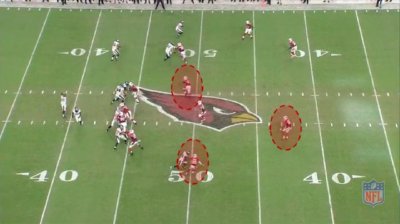
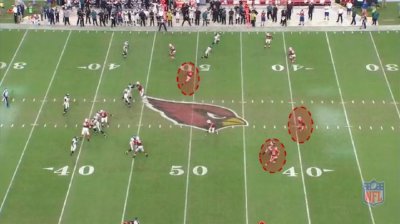
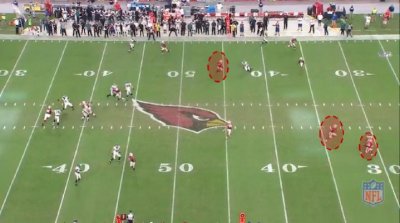
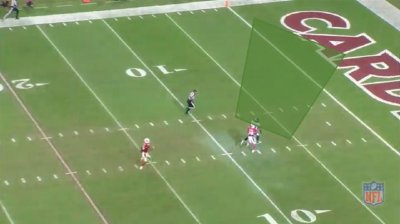
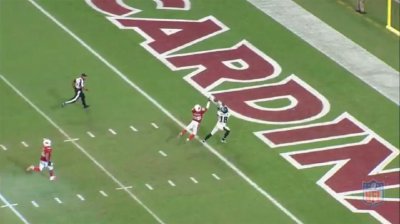
I wanted to look at Jeremy Maclin's 53-yard TD reception in the first quarter because I wanted to pick on Jerroud Powers. After looking at the tape, it looks like Powers wasn't the primary culprit in the big play, but I also took away the limitations that Kevin Minter still has in coverage at this point in his career, the reasons why we're better off blitzing big, and more appreciation for Kelly's play designs.
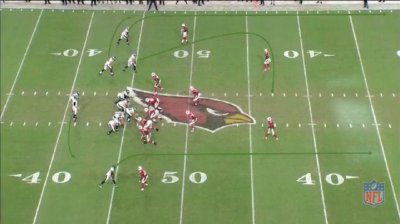
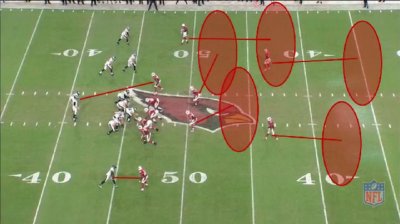
The offensive playcall is pretty great, and unlike most of what you'll see from other NFL offenses. The play comes out of 12 personnel with the tight ends stacked in the slot.
The play also features two designed bluffs. First is a play-action fake to LeSean McCoy as he moves across the formation, and then a fake "smoke" route to the tight end off the line of scrimmage. Both decoy players sneak into the flat.
Meanwhile the outside receivers are running vertical routes with leverage to the left. For Maclin at the bottom of the screen, this gives Foles more space to throw the ball, since the biggest defender in the NFL is the sideline. For Riley Cooper at the top of the screen, his route against the sideline is intended to draw the safety over to provide additional cushion for the coolest route in the play.
The tight end on the line of scrimmage runs an extended wheel route. His first job is going to clear out a defender if Foles decides to throw to the receiver behind him. If that doesn't happen, then he's to empty into the mid-range to threaten the safety who may be drifting over to help on Cooper. If that doesn't happen, he runs a deep "in" route at the sticks.
Chip Kelly's passing game concepts aren't so much about generating matchups, but maximizing the number of opportunities available to the quarterback. It wouldn't be surprising to find out that Foles has the opportunity to hand off the ball to McCoy for a draw (which he doesn't because of the defender on Lane Johnson's outside shoulder), throw the smoke route off play action (which he doesn't because there are three defenders to that side of the field), or hit one of three downfield targets based on the coverage.
Chip Kelly runs one one of the most interesting offenses from a play design perspective in the NFL. Yes, his running game concepts are based on pretty old-school ideas, but his passing game concepts are just mind-bogglingly complex. I'm not sure whether Nick Foles is the kind of quarterback who will end up making the most of this offensive system--he's too limited athletically, too slow mentally, and too sloppy with his throws--but even with a limited player, he's doing some pretty remarkable work.
I wanted to look at Jeremy Maclin's 53-yard TD reception in the first quarter because I wanted to pick on Jerroud Powers. After looking at the tape, it looks like Powers wasn't the primary culprit in the big play, but I also took away the limitations that Kevin Minter still has in coverage at this point in his career, the reasons why we're better off blitzing big, and more appreciation for Kelly's play designs.
The offensive playcall is pretty great, and unlike most of what you'll see from other NFL offenses. The play comes out of 12 personnel with the tight ends stacked in the slot.
The play also features two designed bluffs. First is a play-action fake to LeSean McCoy as he moves across the formation, and then a fake "smoke" route to the tight end off the line of scrimmage. Both decoy players sneak into the flat.
Meanwhile the outside receivers are running vertical routes with leverage to the left. For Maclin at the bottom of the screen, this gives Foles more space to throw the ball, since the biggest defender in the NFL is the sideline. For Riley Cooper at the top of the screen, his route against the sideline is intended to draw the safety over to provide additional cushion for the coolest route in the play.
The tight end on the line of scrimmage runs an extended wheel route. His first job is going to clear out a defender if Foles decides to throw to the receiver behind him. If that doesn't happen, then he's to empty into the mid-range to threaten the safety who may be drifting over to help on Cooper. If that doesn't happen, he runs a deep "in" route at the sticks.
Chip Kelly's passing game concepts aren't so much about generating matchups, but maximizing the number of opportunities available to the quarterback. It wouldn't be surprising to find out that Foles has the opportunity to hand off the ball to McCoy for a draw (which he doesn't because of the defender on Lane Johnson's outside shoulder), throw the smoke route off play action (which he doesn't because there are three defenders to that side of the field), or hit one of three downfield targets based on the coverage.






 I agree karma, Okafor's primary responsibility on the play was not rush but rather contain.